Wednesday, June 29, 2016

5e Hirelings


I recently had cause to include hirelings in a 5e adventure. This is a simple class to represent them, with a feature where if a player character dies, the player can pick up a hireling and continue as a full-fledged character. Until then they are simple to play, competent but with limited options, and largely defined by their skills.

Most of my games use the standard array for ability scores, so for hirelings I just replaced the 15 with another 10. I also use feats, so one human hireling started as an initiate until picking up his second level as a 1st level wizard, and the hunter hireling had crossbow expertise.

Class Features

As a hireling, you gain the following class features.

Hit Points

Hit Dice: 1d8 per hireling level

Hit Points at 1st Level: 8 + your Constitution modifier

Hit Points at Higher Levels: 1d8 (or 5) + your Constitution modifier per hireling level after 1st

Proficiencies

Armor: Light armor, shields

Weapons: Simple weapons

Tools: None

Saving Throws: None

Skills: Skip choosing a background but pick any two skills.

Equipment

Start with a simple weapon and 3 days of rations wrapped in a blanket. Your skill proficiencies grant your other starting equipment.

If you roll or choose the same result twice, increase the associated ability by 2.
  1. Nothing. If you roll this twice increase all abilities by 2.
  2. Acrobatics: 50 feet of hemp rope or 10 foot pole.
  3. Animal Handling: Pack animal or trained dog.
  4. Arcana: Component pouch or arcane focus.
  5. Athletics: Climber’s kit or sledgehammer.
  6. Deception: Forgery kit or disguise kit.
  7. History: Minor icon or journal, pen, and ink.
  8. Insight: Tobacco pipe or journal, pen, and ink.
  9. Intimidation: Hourglass or manacles.
  10. Investigation: Lantern or magnifying glass.
  11. Medicine: Healer's kit or antitoxin.
  12. Nature: Herbalism kit or hunting trap.
  13. Perception: Signal whistle or steel mirror.
  14. Performance: Disguise kit or musical instrument.
  15. Persuasion: Fine clothes or bottle of fine wine.
  16. Religion: Holy water or holy symbol.
  17. Sleight of Hand: Gaming set or thieves' tools.
  18. Stealth: Caltrops or ball bearings.
  19. Survival: 50 feet of hemp rope or fishing tackle and a tent.
  20. Roll again twice.
Then choose or roll one. d4 suggestions for easy-to-run spells follow but you can choose:
  1. Leather armor.
  2. Padded armor and a shield.
  3. Light crossbow and bolts.
  4. Riding mount.
  5. Shield and three spears.
  6. Attendant (All abilities 7, 6 hp, staff -2 d8-2)
  7. Once per session, cast a warlock cantrip (prestidigitation, mage hand, eldritch blast, friends)
  8. Once per session, cast a druid cantrip (druidcraft, resistance, produce flame, mending)
  9. Once per session, cast a cleric cantrip (thaumaturgy, spare the dying, sacred flame, light)
  10. Once per session, cast a wizard cantrip (prestidigitation, message, fire bolt, light)

Level
Features
1
Aspirant
2
Exaltation
3

4
Ability Score Improvement
5

6

7

8
Ability Score Improvement
9

10

Aspirant

Every other character level, you must take a level of another class. This follows normal multiclassing rules, so hirelings don't receive saving throw proficiencies. For example, a 5th level hireling would have 3 levels of the hireling class and 2 levels of any other class.

Exaltation

If your employer perishes, you can take up one of their ideals as an action. If you do so, convert levels of hireling into levels of another, existing class. Your hit dice change to match your class, but not maximum hit points. You gain all the proficiencies a character who started in that class would gain.

You may no longer advance as a hireling.

Monday, May 16, 2016

Bonus and Penalty Dice

These are some rules from my fantasy heart-breaker which I thought could be usefully layered over any system that uses a d20 + modifiers vs. a target.

Circumstances or character aspects may influence your chances of success or failure on a check. These are represented with bonus and penalty dice, which are six-sided. They may be denoted as +#d or -#d, respectively.

When you make a check with bonus dice, if any of the bonus dice come up 6, you succeed, regardless of your d20 roll. Conversely, if you make a check with penalty dice and any of them come up 1, you fail, regardless of your d20 roll.

If you have both bonus and penalty dice, they cancel each other before rolling. For example, if you have +2d and -3d, roll just 1 of penalty die. You never roll bonus and penalty dice at the same time.

If any bonus die comes up 6 and your d20 check also succeeds, that is a critical success.

Likewise, if any penalty die comes up 1 and your d20 check also fails, that is a critical failure.

Conversions

If something in your system would call for a +2 or -2 on a d20 roll, you can substitute one of these dice. They turn out to be about the same - the left column here is a target number, and the header is a character's modifier.


Those hit numbers work because the bonus die only matters if the d20 roll misses. The highlighted parts are where most rolls seem to happen, at least in the early levels of the game, or in a lower-powered one.

These dice become less important for skilled characters to succeed, but do help in avoiding mistakes and in driving crits. They reward less-skilled characters for seeking them out.

Almost everything in my game got converted into bonus and penalty dice, so the d20 rolls changed infrequently, since they were based on ability scores. You don't have conditional modifiers to tack onto the roll - they are all individual dice, with no math involved.

That also means there aren't something that would translate as conditional +1 modifiers, but I have never much liked them anyway.

Some character aspects could give bonus dice, but mostly they're situational. Charging? Bonus die for everyone! Attacking something invisible? Well, have a couple penalty dice.

Also note you can't crit or fumble without an extra die. You really want to seek out bonus dice for this reason, either to line op the crit, or negate the possibility of a fumble.

Adding more dice in either direction scales the chance of success or failure interestingly, though I think getting more than 3 in either direction would be rare.

  1. 17%
  2. 31%
  3. 42%
  4. 52%
  5. 60%
  6. 67%

I also ended up getting rid of a lot of level bloat by relying on these dice. If you were facing off against a thing of a substantially higher level, you got a penalty die, and it got a bonus die. Same thing if weaker opponents were facing you.

Monday, May 9, 2016

Fun With Some Blunderbusses

Some magical blunderbusses (blunderbi?) because why not. Assuming 5e but you're adaptable.

Wonderbuss

When you roll a natural 1 on an attack roll with this weapon, roll on the Wand of Wonder effects table.

Thunderbuss

Attacks with this gun deal an extra d6 thunder damage. When it rolls a natural 1 on an attack roll, all creatures in 10 feet of you (including yourself) must pass a DC 15 Fortitude save or take d6 thunder damage and be deafened for a minute.

Blunderpus

Advanced artillery now available in convenient liquid form. Poured from its bottle, this thick, milky liquid permanently forms into a serviceable large bore shotgun in a round. If you drink it (and why wouldn't you) you can spit shot for a minute (assuming you have shot).

Chunderbuss

You can use rations as ammunition for this weapon. If you do it deals an extra d6 acid damage and is terrible.

Plunderbuss

Muzzle acts as a bag of holding, but fires a random item from its store on an attack roll of 1.

Numberbuss

If you roll doubles on your damage dice on attacks with this weapon, roll them again.

Günterbuss

This weapon is named Günter. He has Intelligence 10, Wisdom 11, and Charisma 9. He can speak, read, and understand common (but he can't speak on a turn he's used to attack, because his mouth is firing shot, of course). Hearing and normal vision out to 120 feet. Neutral alignment and seeks his creator.

Günter can chew up pretty much anything for use as ammunition, but he prefers wine casks and coal.

Sunday, February 7, 2016

All Manner of Devilry

These items were created by devils for use against their own kind. They might be granted as boons to mortals who assist a fiend in the removal of some threat or rival, or be stolen and turned to more noble purpose.

Lysis Blade

Weapon (longsword), rare (requires attunement)

This item appears to be a longsword hilt. While grasping the hilt, you can use a bonus action to cause a blade of wan, gray-green light to spring into existence, or make the blade disappear. While the blade exists, this magic longsword has the finesse property. If you are proficient with shortswords or longswords, you are proficient with the lysis blade.

You gain a +2 bonus to attack and damage rolls made with this weapon, which deals acid damage instead of slashing damage. When you hit a fiend with it, that target takes an extra 1d8 acid damage.

The sword’s dolorous blade emits dim light in a 20-foot radius. Within that woeful light, even if suppressed by darkness, the Devil's Sight ability is suppressed.

Winding Cloth

Wondrous item, rare (requires attunement)

You gain a +1 bonus to AC and saving throws while you wear these tattered rags as a cloak.

You can spend a hit die to cast Speak with Dead as a ritual. Roll that hit die to determine how many questions the corpse answers.

Ring of Retribution

Ring, rare (requires attunement)

This ring has 3 charges, and it regains 1d3 expended charges daily at dusk. When you take damage, you may expend a charge and use your reaction to cast a cantrip you know.

Vuch-Cuch

Weapon (mace), legendary (requires attunement)

This three-pronged mace was once the scepter of a recently slain devil lord. Wrought of iron and fiend-leather, it desires a return to its former stature, viewing hellish ranks as challenges and mortals as vessels.

You gain a +3 bonus to attack and damage rolls made with this magic weapon. You can use a bonus action to make an attack against a fiendish or undead creature with it.

When you hit a fiend or an undead with this magic weapon, that creature takes an extra 2d6 thunder damage. If the target has 25 hit points or fewer after taking this damage, it must succeed on a DC 15 Wisdom saving throw or be charmed until you take a short or long rest. On a successful save, the creature becomes stunned until the end of your next turn.

While you hold this weapon, no light can shine brighter than dim in a 40-foot radius.

Tines of Power: At any time, Vuch-Cuch can maintain up to three shards of itself. These manifest as iron daggers, with +1 to hit and damage. The wielders of these knives have disadvantage on saving throws against spells cast by Vuch-Cuch or its wielder, but advantage on all saving throws against spells. If Vuch-Cuch is destroyed, it will regrow from one of these knives in three days.

Rebuke the Petulant: When you score a critical hit with Vuch-Cuch, you may use a bonus action to cast magic circle targeting fiends and undead centered on yourself. This effect lasts for 1 minute as Vuch-Cuch shrieks and mutters true names.

Sentience: Vuch-Cuch is a sentient lawful evil weapon with an Intelligence of 13, a Wisdom of 12, and a Charisma of 14. It has hearing and normal vision out to 120 feet.

The weapon communicates empathically with its wielder, desiring decisions which lead to leverage and power.

Thursday, September 3, 2015

The Gods in the Sky

This is a pantheon for an upcoming 5th edition game. The things in the sky, the suns, moons, comets, and stars, are god. They are not worshiped as gods, they are not manifestations of gods - that sun, that moon, is a living entity of massive power that tugs on your own life.

Each god aligns with one or two of the 5th edition clerical domains, and holds several things as sacred to itself. In the game there will be a deck of cards dealt out to the group as a meta-game - that will probably be another post, but I'll use their images here.

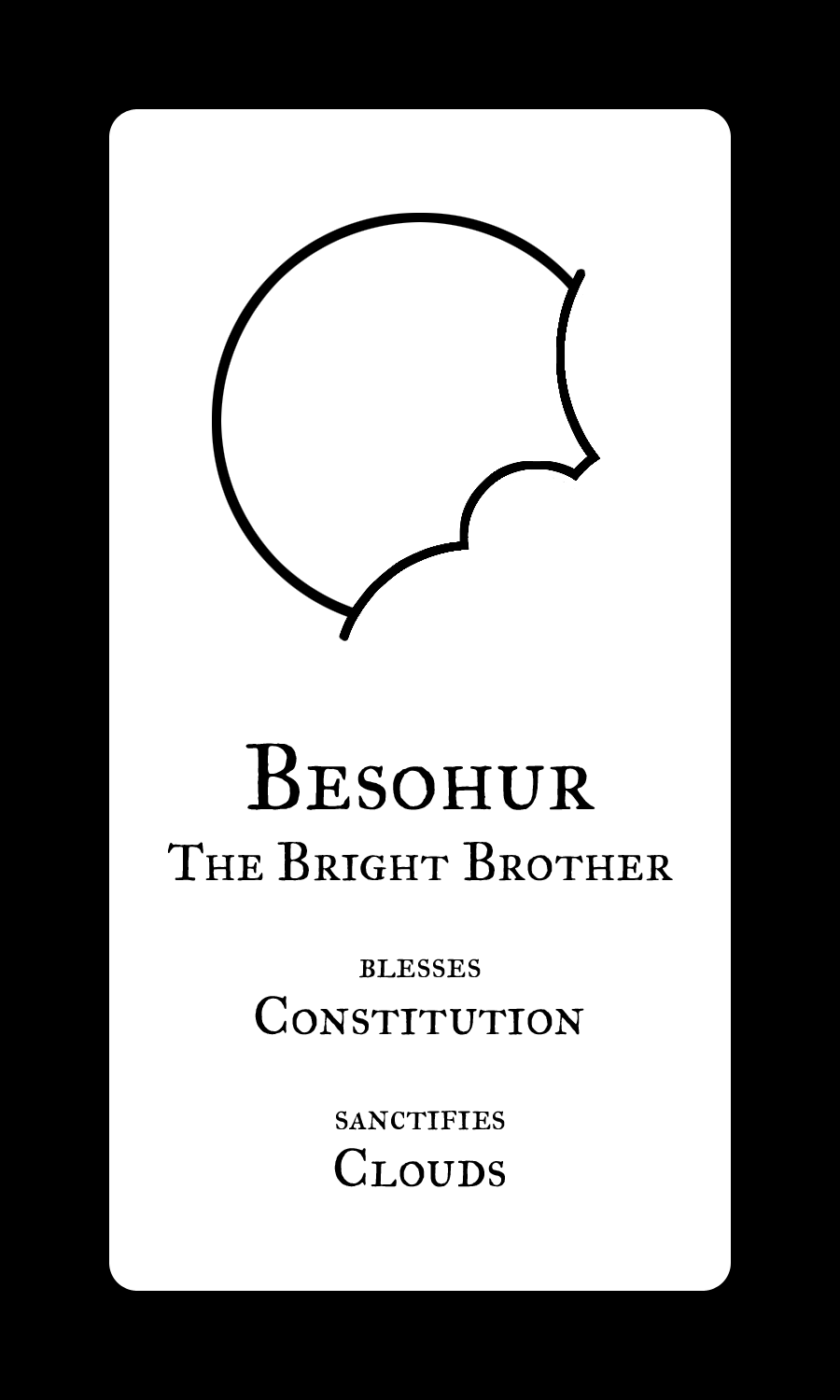
Besohur, the Bright Brother

Holds Sacred: Hearts, Gold, Clouds, Bread.


The bright, warm, yellow sun. Clouds are his children, who play around him, and watch the sky as he rests.

Life & Tempest Domains

Everything that walks under the sky is considered by Besohur. His light and the rain of his children nourish them.

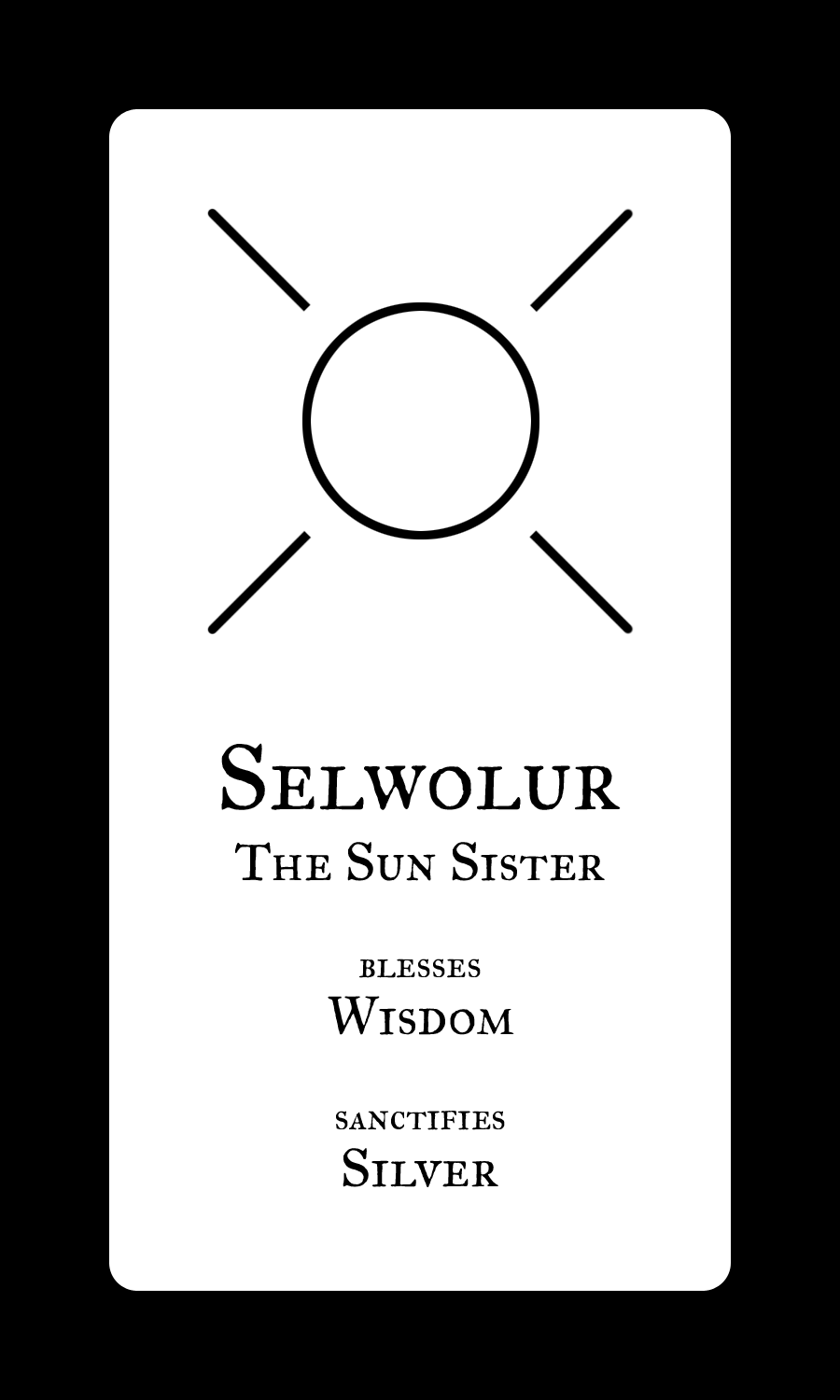
Selwolur, the Sun Sister

Holds Sacred: Eyes, Silver, Arrows, Maps.


A tiny, bright-white sun whose radiance pierces the clouds. She sometimes brings a half-day of harsh shadows when it would otherwise be night, defying the moons.

Light & Knowledge Domains

Selwolur appears suddenly, thirstingly, pressing through darkness and mist, illuminating secrets and dark places.

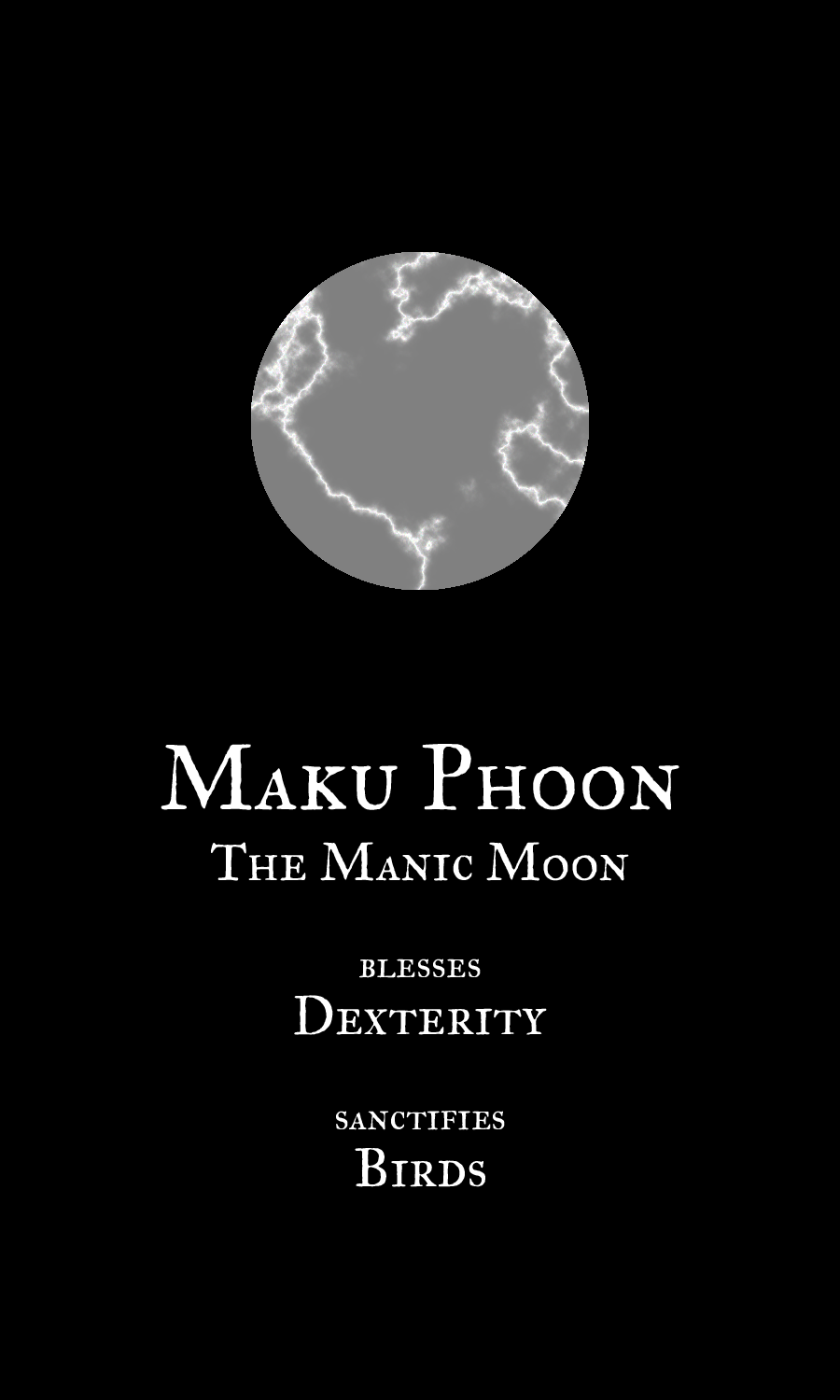
Maku Phoon, the Manic Moon

Holds Sacred: Tongues, Copper, Birds, Wine.


This silver-gray orb roils across the sky, flashing with lightning. Of the moons, it is most commonly seen in the day, seemingly taunting Selwolur.

Tempest & War Domains

Maku Phoon is a herald of destruction and panic. Its whelming alien storms sometimes whip Besohur's nourishing children into a thunderous frenzy. Under its strobing gaze, tempers flare and wills crumble, swords are unsheathed and blood flashes like lightning across the pulsing sky.

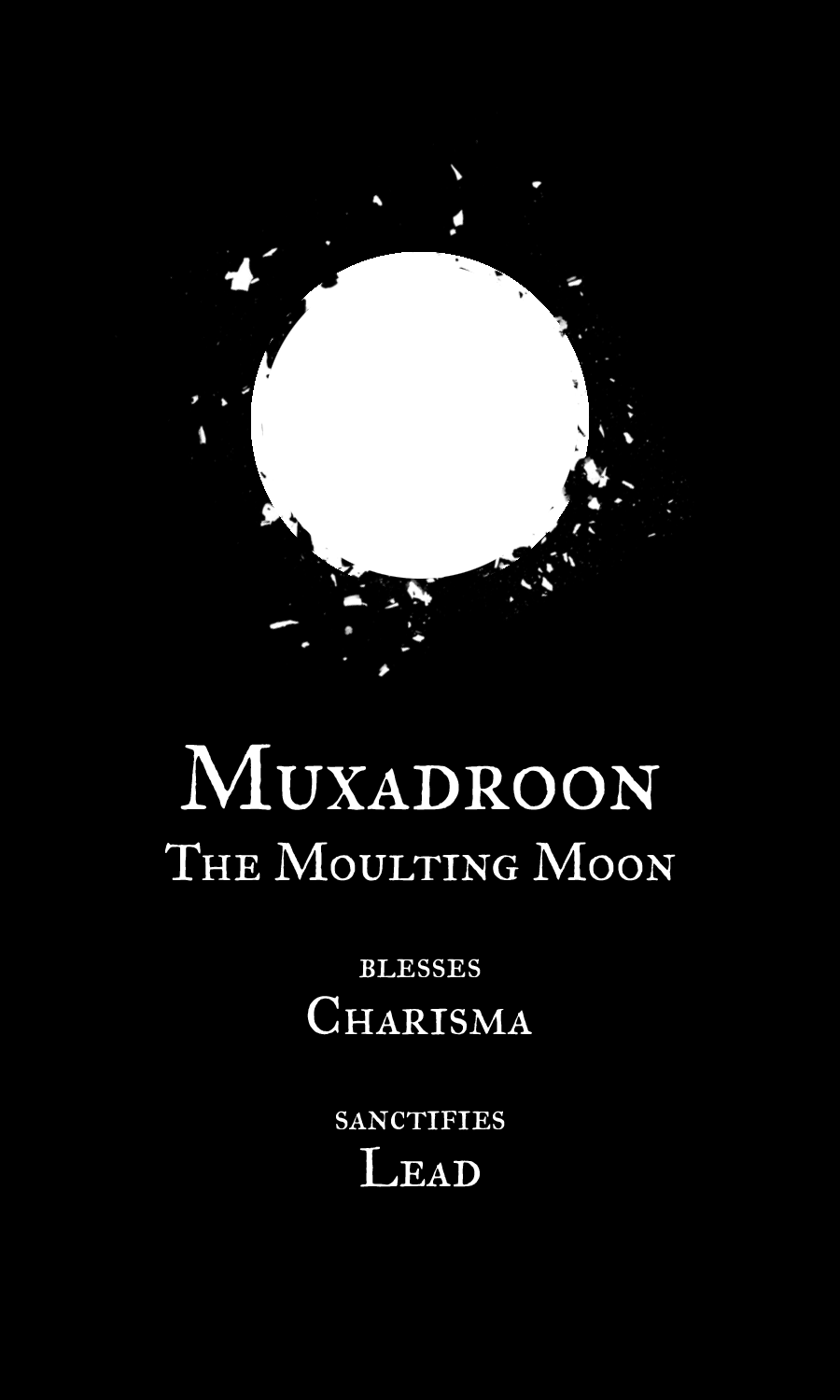
Muxadroon, the Moulting Moon

Holds Sacred: Bones, Lead, Insects, Knives.


A stark white moon, clouded with debris and riddled with craters, which creeps across the sky. Flakes sometimes crash to the ground, bearing strange creatures.

Trickery & Life Domains

Unlike Besohur's holdings, all life that springs and spurts in darkness sways to Muxadroon. Worms and beetles that gnaw in hidden places are its.

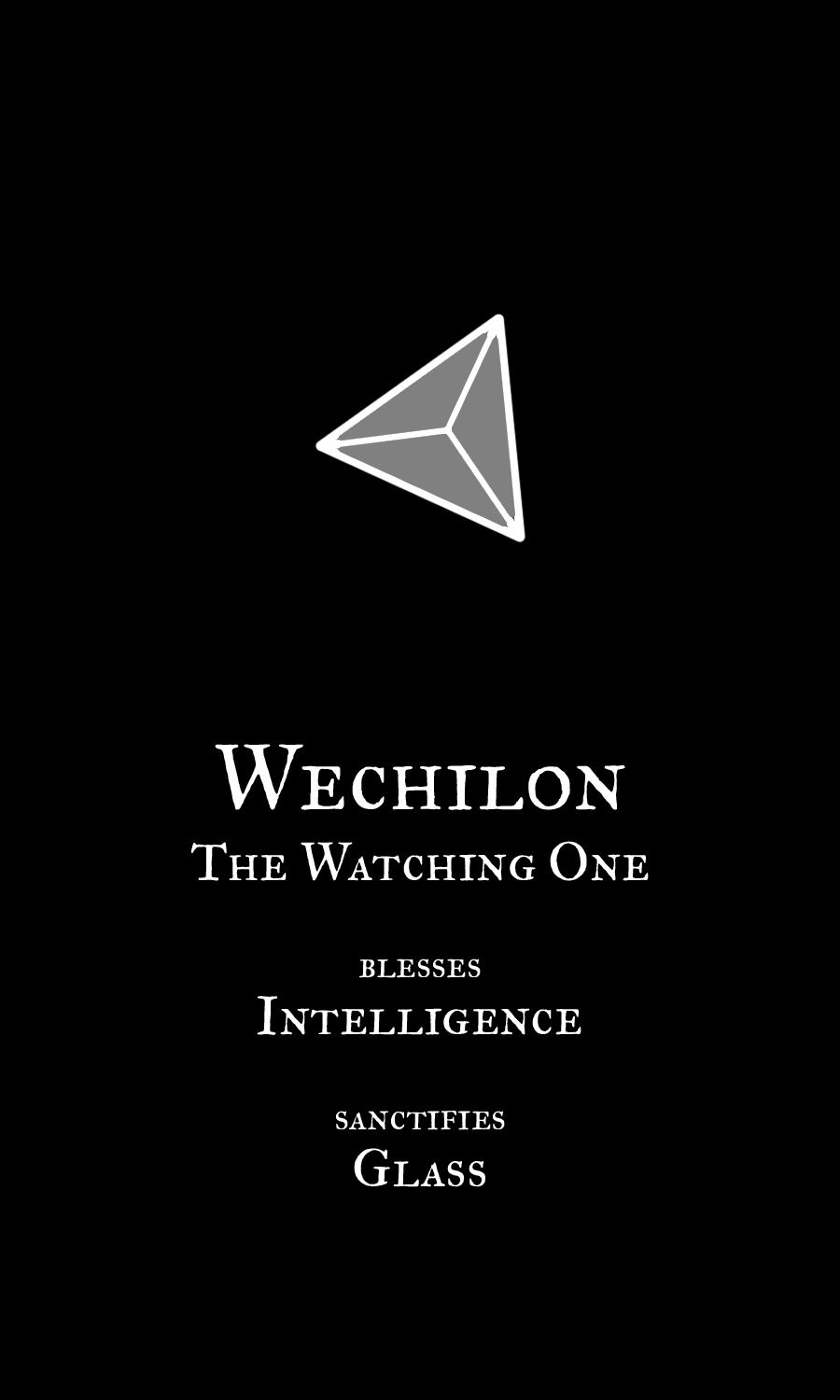
Wechilon, the Watching One

Holds Sacred: Brains, Glass, Chalk, Wands.


A four-faced pyramid of metal, struck with channels and runes. Its face shifts abruptly to no pattern discovered by astrologers. It is well known that in ages past Wechilonwas the world's arch-mage who ascended to her great palace in the sky and assumed the mantle of godhood.

Knowledge Domain

Whereas Selwolur is the goddess of knowledge uncovered and shared, Wechilon is the goddess of knowledge secreted and horded. She is often revered by mages.

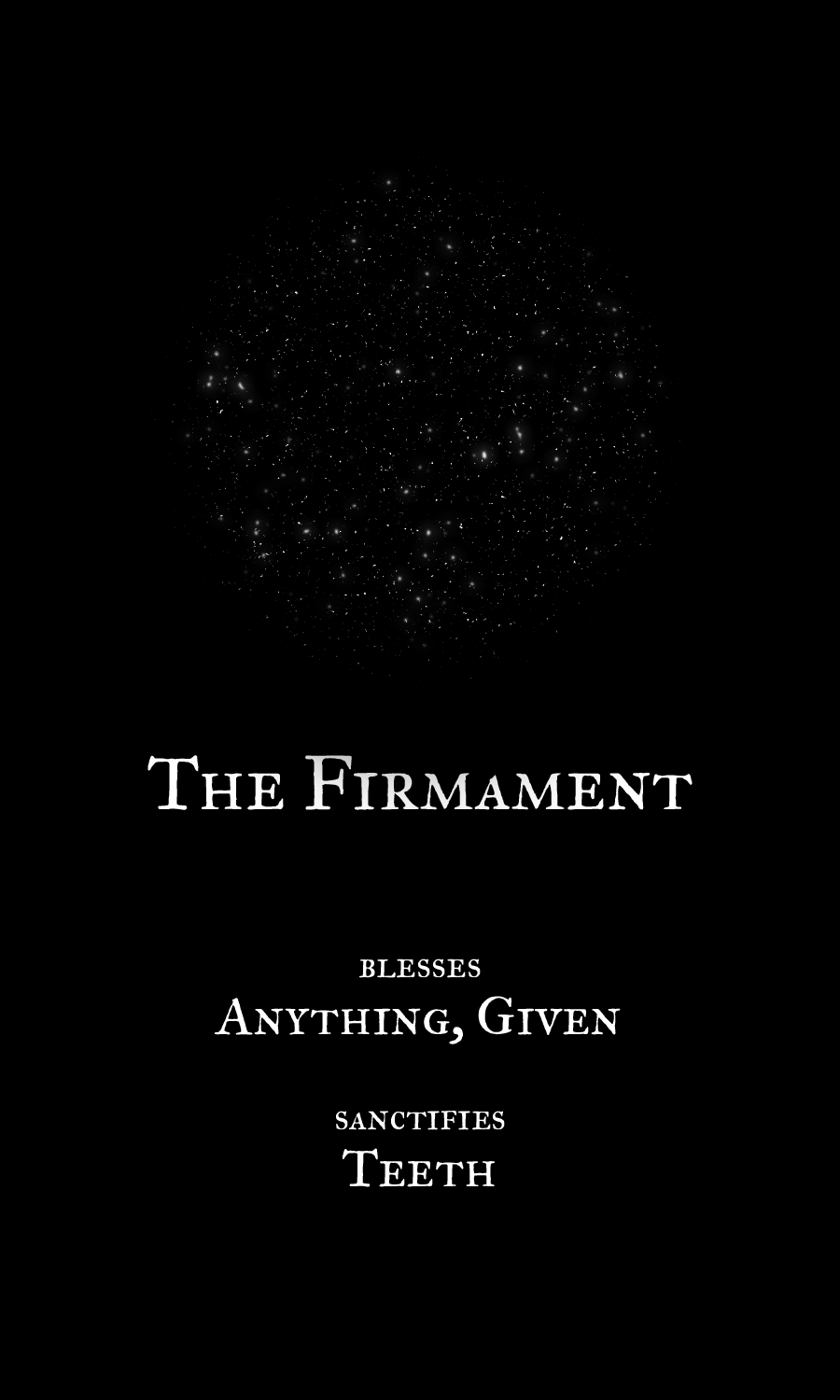
The Firmament

Holds Sacred: Teeth, Wood, Caves, Flowers.


All the stars in the heavens. The innumerable constellations embody every creature or plant or swath of weather.

Nature Domain

Besohur cares for the health of the world, but there is a place in the sky, yes, there, those eight stars, that cares very much for the health of wheat. And those dozen, to the left, Muxadroon wishes well for all insects, but those twelve look down upon the pillbug. They happen to share two stars, you say?

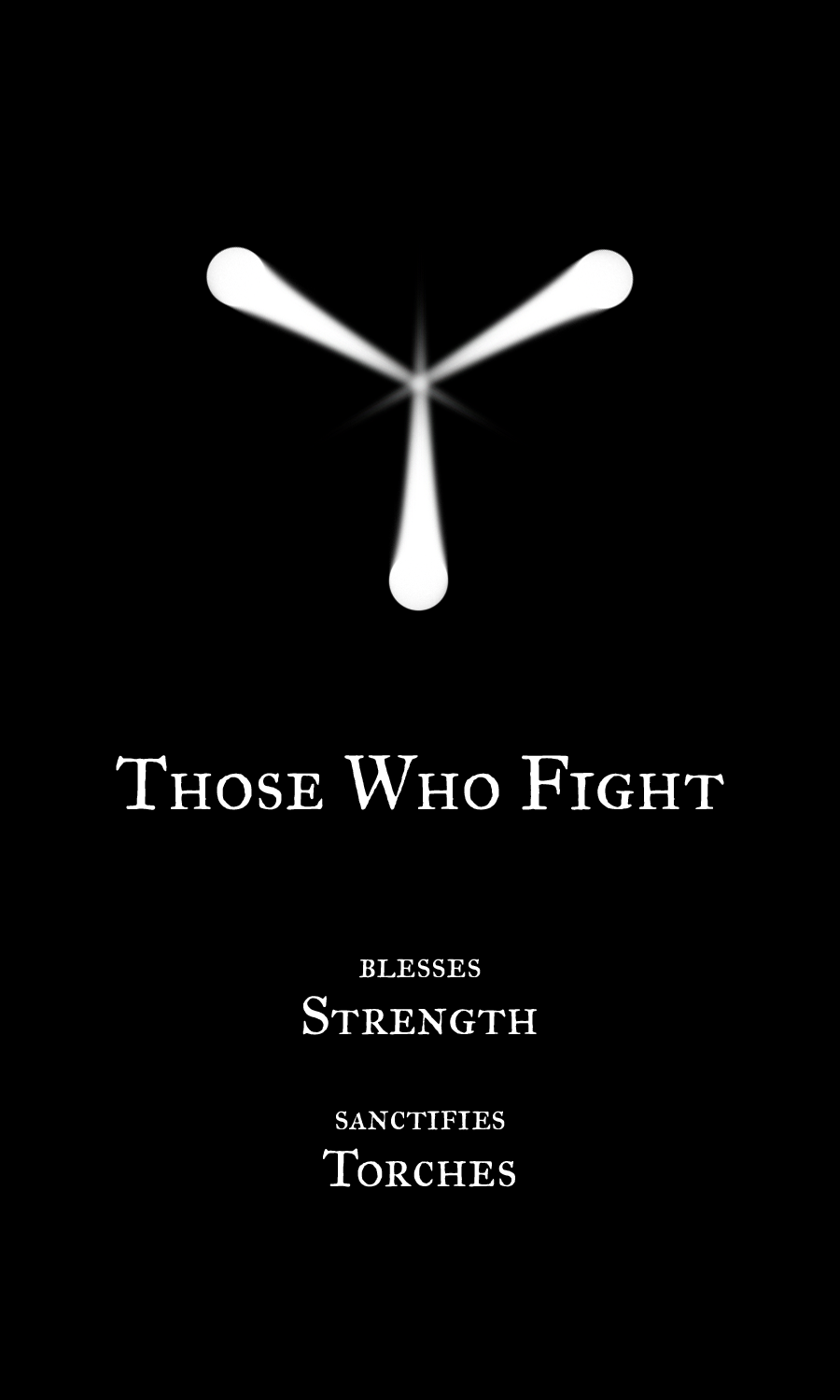
Those Who Fight

Holds Sacred: Hands, Steel, Torches, Salt.


No one god holds dominion over Those Who Fight. These brave spirits cross the sky, trailing their life behind them, fulfilling the mercenary campaigns of whichever deity can rally their services.

War Domain

Comets ply from star to sun to moon to horizon, flaring into existence, burning their path across the Firmament, and winking out.

Naught

Holds sacred: Nothing.


There is a place in the sky with no stars, which the suns and moons do not cross. Those Who Fight who cross it cease their battles. There is Nothing there.

Death Domain

An end to life and light. No truth or falsehood, no rage or rebirth. Unknowable. The end of all things.

Monday, August 17, 2015

Encounters in Sick Country

Like backwoods, or badlands, sick country is a way to describe a place. There are patches of sick country scattered through the Land of Still Waters, some huge and well-know, helping shape the boundaries of nations, others tiny and ephemeral.

T E K K N O I R

Boundaries of sick country are sometimes vague, sometimes well-defined. They shift, tidally, as the forces in the sick country wax and wane. Locals know the boundary signs of any nearby sick country well and often have extensive myths or traditions regarding them.

Though borders may shift, most sick country has a definite center or focus. Here the virulence of the place intensifies and creatures driven from the settled frontier shelter. Often this locus was a city of the ancient world whose ruins may still be seen from afar. Travelers through sick country would do well to give these relics wide berth.

witch by algenpfleger

The largest known sick regions bear the names of the ancient cities at their epicenters: Boston, New York, Toronto, and Montreal. The nation of Jorvik has many smaller regions within it whose borders are well-patrolled. Northern Vye contains Ottawa, and the southern shore of Acadia is blighted by Portland.

What do you encounter?

Roll three Fate dice. At the edge add another die and discard the lowest. Deep in sick country add another die and discard the highest.

Fate dice show 2 blank, 2 +, and 2 - sides.

+3: Settlement
+2: Wanderers
+1: Animals
0: Landscape
-1: Phenomenon
-2: Beasts
-3: Monstrosities

If you want to roll for encounter distance:

+1: Immediate: Ambush; stumbled upon; exits cover nearby.
0: Sighting: Raised dust or smoke; against the horizon; sounds.
-1: Hint: Trail or spoor; remains of a camp; aftermath of a battle or hunt; territorial markings.

Inhabitants

  
Even sick country may be settled, though sparsely, and as close to the edge of safer lands as possible. Land here is cheap or unclaimed, the law is scarce, and there are opportunities for those brave or desperate to seize them.

This section is applicable to both Settlements and Wanderers.

Two dice to determine how do they live.

At the borders of sick country, roll three dice and discard the lowest - in the depths, discard the highest of three. Consider rolling twice and combining the results to get a more nuanced or intense motivation.

+2: There are those who intentionally travel through sick country as benefactors: missionary or Ellisian walker; hermit; messenger; mercenary.
+1: Settlers having some degree of success: farmers; merchants; bandits & toll-takers; an outpost of a nearby borderland or nation.
0: These people are struggling: scavengers; living off limited supplies; paying fealty and tithes to some nearby settlement; failing and likely doomed.
-1: Hunters venture into sick country for many reasons: trappers; trophy hunters; furriers; exterminators. Those passing through unsettled lands should be wary they do not spring some forgotten hunter's trap.
-2: Aside from the natural hazards of these lands, anyone living in sick country is unlikely to be missed in civilization. They attract abductors: the autumn people; bounty hunters; cultists hunting for recruits and sacrifices; a witch of the wastes.

And one die for why are they here?

+1: Seeking opportunity: indebted; cheap land; exploration; salvage.
0: Long-time inhabitants: born here; making it work; delusional; infectious and unwilling to return to civilization.
-1: Exiles: Displaced; usurped; apostates or heretics; fugitives from the law.

Settlements

http://darkclassics.blogspot.com/2015/06/carl-georg-adolph-hasenpflug-church.html

Structure - two dice

+2: Manor
+1: Homestead
0: Village
-1: Hamlet
-2: Campsite or hut

What state is it in - two dice

+2: Heavily fortified
+1: Under construction or temporary
0: Kept in decent repair; perhaps walled
-1: Re-purposed or adapted from other structures
-2: Crumbling; ruined; or badly damaged

Then roll on inhabitants to find out who lives there.

Wanderers

All 

Wanderers may be: displaced from their homes and looking to settle; Glist; long-time nomads; just arriving in sick country; utterly lost; taking a dangerous shortcut; trying to hide.

Animals

owl4.jpg (800×592)

Normally these creatures are benign, but many are host to sicknesses which may cause unusual behavior. An encounter with otherwise normal animals may serve to unnerve travelers, or restock their supplies.

Two dice:

+2: Foragers: escaped horse or ghast; wild sheep; deer; trollizard.
+1: Birds: ravens; sparrows; hawk or owl; gulls.
0: A swarm of insects: caterpillars; moths; roasps or roaches; ants.
-1: Rodents: squirrels; rats; rabbits.
-2: roll on Beasts.

Landscape

A mutated pine tree against the backdrop of the nuclear plant in Chernobyl.  Photo credit: Igor Kostin 

Much of sick country appears normal, like the land that surrounds it. The are regions though where even the earth seems to take ill. Often these places are known to and named by the surrounding natives - Toadwood, Norman's Rot, the Aching Cliff.

Three dice.

At the borders, roll four and drop the lowest. In the depths, roll four and drop the highest.

+3: This land offers respite: wax reeds well-adapted to any nearby sicknesses; a walker grove; a seemingly empty and stocked shelter, well-hidden; a length of ancient self-repairing road is clear and easy to travel.
+2: Teeming with life: obscenely plump and verdant plants, humid and heavily scented; swarms of flies or rats or birds with no obvious food source; fearless and hyperactive wildlife; roiling mist full of unseen chirps, hoots, and squeals.
+1: Passing through tended lands suggests a settlement nearby: farms; trails; orchards; pasture.
0: There are some plants which seem to thrive in the sick country and their abundance should serve as a warning to travellers: willow; sunflowers; pigweed; mustard.
-1: A wasteland of: parched dead trees; twisting thorn scrub; scorched and glass-like barrens; rusted ruins.
-2: This water is: vibrantly wrong color; stagnant and fetid; slick with oil and toxins; clear and still but utterly devoid of life.
-3: Blighted with: fungus and slime molds; miasma; rift in the earth; ethereally poisoned.

Phenomenon

*The Dry Tree Tomb, (secret location), here lie the remains of ...

Higher numbers are not necessarily good or safe, but they can be more easily avoided and might yield salvage if investigated.

Two dice.

At the borders, roll four and drop the lowest. In the depths, roll four and drop the highest.

+2: Haunts are warded regions created generations ago that try to scare the curious away from the dangers they hold. They send out periodic ethereal scouts to keep abreast of what's scary these days and manifest them with a variety of illusions and shifting facades.
This haunt: broods over a great plague; is slowly breaking down; has turned malevolent; might reward or bribe those who brave it.
+1: An ancient building: perfectly preserved; partially buried or obscured; active with magic and guardians; finally succumbing to the centuries.
0: Roll on the sickness table. This place is rife with the result.
-1: Zones of ethereal flux in which magic is: dead; wild; empowered; sentient.
-2: Radiation lingers in this area. It is a pernicious threat often undetected until one is deep within its boundaries. The animals and plants here are warped; the place glows faintly in the darkness; headaches and nausea begin quickly; everything appears normal to the naked senses.

Beasts


These creatures pose some risk to travelers and settlers. They are not necessarily hostile, though many of them are hungry or diseased.

Two dice:

+2: Feral animals have lost much of their fear of humans: wight; wild dogs; trollizard; cat.
+1: Most predators will only attack humans if they are hungry or threatened: wolves; coyotes; bears; bobcat.
0: Scavengers: dire rats (these are descended from Gambian pouched rats); wild dogs; hop crow; amphisbaena.
-1: Garoulin: regular garoulin; wolf-garoulin half-breeds; look like dogs but are smart as average garoulin; magic-using.
-2: Roll on Monstrosities.

Monstrosities

https://blogger.googleusercontent.com/img/b/R29vZ2xl/AVvXsEiAbue4hNIju5mnpUt4bV6e1eQym95o5iPPDLZcQp-i7JgtWgDVh3yyaevLTmlYOGITjxBaiwEhZ8_MOYfr8ctN8qqACEn295vJPJfrylDnB-NAw8hcEKy95nfwNZhy1_q_SSEelJXosIU/s1600/swamp_thing_by_Rheann.jpg

Three dice:

+3: Chimera: their artistries; their servants; or they themselves.
+2: Fey other than beguilers are somewhat less common in sick country but not unknown: sprite; goblin; gnome; nymph.
+1: Undead can rise spontaneously or are sometimes released by cultists: zombie; ghoul; wraith; revenant.
0: Lesser thaaskith roam wild here, escaped from or released by the cults. Amphisbaena; jaculus; basilisk; tatzelwurm; cerastes; or cockatrice.
-1: Fargone, or something on its way there: viscerid; luxpuck; tallow; ogre.
-2: Beguilers, the succubi and inccubi, are known to hunt the sick country for the weak and undefended. They may be: whole; decayed; traveling with thralls; recently fed.
-3: Greater thaaskith; rampaging lindorm; medusa on a vision quest; naga travelling between temples; samaelisk, possibly with converts.

Sick

Unsurprisingly, things encountered in sick country are often sick. For any encounter, you may use this chart as many times as you like.

Roll three dice to determine the nature of the sickness:

LiveJournal Images | castlin.net

+3: Maniacal: frenzied & murderous; screeching & terrified; gasping & ecstatic; relaxed & psychopathic.
+2: Stupefied: idiot; animalistic; delirious; forlorn.
+1: Blind: cataracts; seeping eye holes; put out; eyes look fine but don't focus.
0: Disfigured: hunched; spindly; twisted; palsied.
-1: Diseased: leprous & rasping; fevered & sallow; bloated & oozing; wheezing & hacking.
-2: An old plague: clear plastic skin; partially ossified; cysts & vestigial limbs; ethereal siren (agonizingly loud for the afflicted and anyone sensitive, attracts attention in the ether).
-3: Fargone: luxpuck (skeletal and luminous); ogre (rippling muscle and insatiable hunger); tallow (bones soften, flesh flows); viscerid (must survive on the harvested organs of others).

A fourth die can determine how contagious the sickness is.

Julian Callos 

+1: Non-contagious: congenial; dormant; too specialized to host.
0: Moderate: wounds or injection; consumption; handling or grappling; imbued in an object.
-1: Virulent: airborne; bodily fluids; ethereal; skin contact.

Even non-physical ailments can be contagious in sick country.

Reactions

If you want a quick behavior, roll one die:

+1: Ignores, possibly curious
0: Observes, possibly stalks
-1: Aggressive, probably attacks

For a more nuanced behavior this encounter will tend towards, consider rolling three dice on this table. You can add a die and drop the lowest on the edge of the sick country, or add a die and drop the highest deep in it. Player actions and attitudes can guide these reactions.


Initially appear
and soon turn
because they are
+
Welcoming
Helpful
Principled
0
Cautious
Indifferent
Hungry
-1
ThreateningAggressiveAfraid

Sunday, April 19, 2015

Workings of The Fey of the North Woods

They wear tall bodies made of detritus - seven or ten feet of stone and snapped branches and bones, studded with ice, cloaked in dust and delicate fibers. Their cities are their own enormous, abandoned husks, wrought of earth and roots twisted into hollow, organic shapes.

They do not fear death, their bodies are costumes. They are inviolate blue-white stars which flit into the sky should their vessel fail. Other things die and their passage is viewed as some act, some jest, the conceding of a delightful game.

Here are some things they make to pass the time.

Elf-Light

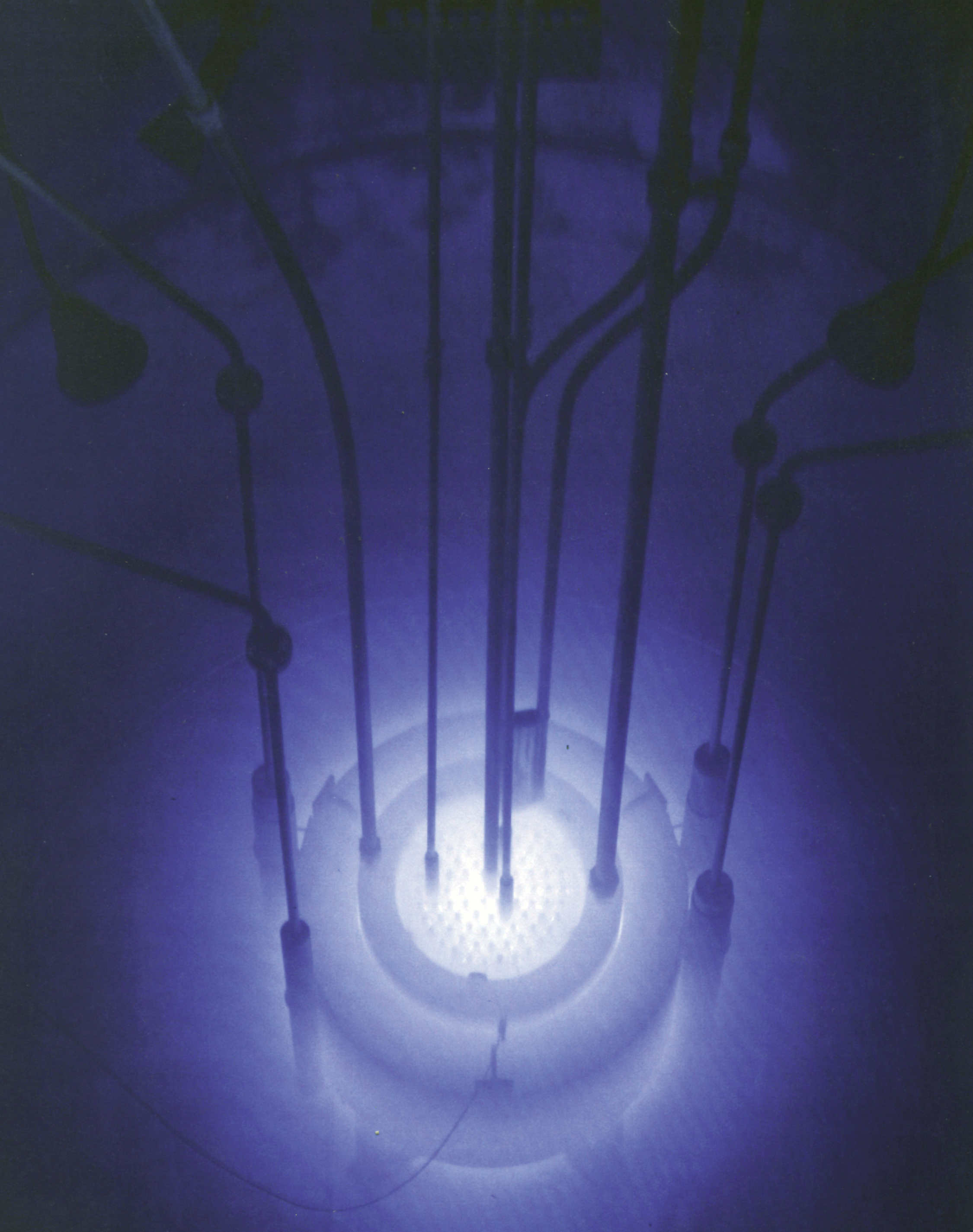
Elf-light springs from pinpoints into rays which hurt to look at directly. It illuminates its immediate space with harsh, actinic brightness, but casts no shadows or gentle wash of radiance.
Elf-light loves illusion. In its Cherenkov rays glamors are enhanced.
Chrenkov effect reactor
Like this, but trees.

Elf-light loves to have the eye drawn to it. It's easy to hide in the non-shadows it casts into the places it isn't.


Elf-light loves supplicants. Plants which grow in it flourish in pulpy profusion, lolling with fat, pithy fruits. Deprived of it or exposed to sunlight they quickly curl and wither.

Organs

Fey of the north woods craft their physical bodies from available natural materials, but sometimes incorporate items of their own delicate workings into the vessel.

In the hands of other races these contrivances can usually be exploited to some benefit. With sufficiently powerful magic or surgical acumen members of the fleshy races may take full advantage of these strange items by grafting them into their own bodies. The items make no accordance for implantation or substitution on their own.

Sometimes the elves have been known to grant a graft as a gift. The recipient has not always been willing.
  1. A wand composed of a single ray of elf-light. It can trace patterns and signs in the air which linger as cold light for hours. Against incorporeal beings, the wand slashes as a blade, and the lines it leaves are impassable.
  2. Wooden antlers which branch into fine points across a yard or more. Stroking the branches auguries the past or future, but the user experiences time in between now and the subject. For every 10 years queried into the past or future, the user ages 1d10 years. Anyone killed by the aging rises as a wight.
    Grafting the antlers to your skull reduces the aging to 1d10 years per 100 years and allows you to gore opponents with them. Those such injured quickly turn to stone.
  3. You are difficult to frighten while you clutch this black-brown hedron from which jut matte grey crystals. The crystals breach painlessly through your skin, emerging from your knuckles. Both hands gain incredible grip and it becomes extremely easy to hold someone still with one while you beat them senseless with the matte grey crystals protruding out of the other.
  4. This fragment of armor, a gauntlet, a greave, a faceplate, is made of seamless and pallid stone. The wearer is incapable of spectacular failures on their attempted actions, but likewise, spectacular successes.
  5. A strange flute of rubbery blue fibers, pocked with five holes. Played as an instrument it can, occasionally, replicate a lesser fey spell.
  6. White-rinded fruits with purple juices which remind flesh it must quit, cursing those who consume them.
  7. A fist-sized orb of polished fine-flecked gray and white stone . It may be set in a rod or a necklace. When the bearer takes magical damage, the gray flecks grow and the white flecks shink. Vice-versa for physical damage. In either case, the damage taken is significantly reduced, but if the orb ever becomes all white or all grey, it shatters.
  8. A wooden idol with gently twitching roots, seemingly formed from a single stump. If planted in the soil, miles around it soon become abundantly fertile as long as it remains planted. All who feed regularly on its bounty are susceptible to the influence of the fey.
    If the idol is uprooted, roll d6:
    1. All those made susceptible to fey influence through its nourishment die. They rise as zombies under the new moon and seek to destroy first anything living, then each other. Over the course of a month they will slowly twist and harden into new root-idols.
    2. Under starlight, the uprooter's skin irreparably becomes hard and knotted. Within minutes, unprotected, they become a new root-idol.
    3. The idol shrieks as it dies, rupturing glass and ears.
    4. Sowbugs and centipedes boil out of the idol's hole as it writes and dies.
    5. The idol silently falls to damp, rotten chunks.
    6. A treasure of silver ore and unworked gems is unearthed below the idol.
  9. Hard and tapering seed which collapses a huge area into itself shortly after being planted, then splits into dry and worthless pith.
  10. An anti-wind, a void, which sucks and howls and devours light and sound. Normally tiny and dormant, one with sufficient will can rouse it to service and direct its attention. It feeds on confusion and nightblindness.
  11. A chunk of cold, cold white crystal which spews coils of dense vapor. Carried on a staff or wand, it can be commanded to shroud a large area in mist, though doing so risks depleting the crystal.
    Embedded as an organ, the bearer constantly trails vapor from their mouth and can easily exhale a huge mass of obscuring mist. 
  12. A pale, matte-green crystal which forms a seemingly natural dodecahedron. It may be mounted in a piece of jewelry or breastplate. When the bearer is accused of any wrongdoing, the blame is evenly spread between them and the four nearest possible culprits.
  13. A spindled, skeletal hand of spun glass, jointed with silver wires. Worn as medallion or carried atop a rod or staff the bearer can perform minor feats of prestidigitation.
    Should a hand's structure be replaced with these glass bones, the wielder can easily manipulate objects from afar, and project beams of punishing light from their fingertips.
  14. A fibrous staff whose rich-red base tapers and fades to a fine white point. Anyone struck with it or exposed to a blast of its miasma quickly undergo a metamorphosis as a similar stalk burst from their neck, scalp, or face, growing to several feet in length, curving up. Those such decorated are compelled to follow the commands of the staff-bearer until the growth is destroyed.
  15. This mask, woven from fine, woody vines, radiates gray elf-light. It is difficult to see through, but you cannot be blinded or subjected to creature's gazes while wearing it. With sufficient concentration, you can coalesce the mask's glow into a ray of blinding light.
  16. A delicate chain of glass links. Worn as a necklace or belt, it projects an idealized story of your movement - you seem to glide and sweep airily through any situation. The chain struggles with any display of gross incompetence, however. If you trip or are moved against your will, there is a chance it will shatter.
  17. A clear and languid draught in a shallow stone bowl which forgets for its imbiber, casting memories as stakes in a game of lots with the stars. The stars are very good gamblers, but if the imbiber wins they get some new memories, and likely the enmity of the stars.
  18. This elf-light is a sheen of harsh, yellow light breaking over a dark verizon, a pillar of dawn, regardless of the angle from which it is viewed. Anything held in its glare disintegrates in a heatless flame, scattering to colorless ash in moments. The terrible light cannot be moved or handled directly but it slowly glides into the nearest space which is darkest.
  19. A pitted stone dart which, when released, assassinates up to five nearby fires, one-by-one.
  20. A diadem of light and shining metal. It ignores a shock or afront for you. Until later. Much, much later, when you're alone, and the reverberations can literally shatter you.
  21. This mace of drab green rock specked bone white and brown hardens and deals grievous wounds in the presence of betrayers.
  22. A cloak of floating dust motes which quiets weight, allowing one to drift and bound under a night sky, but also risking being drawn up into that great silence above.
  23. Striated gray mineral cube which seems to squeeze out and absorb deep crimson nodes. Pressed into a wall, it reshapes it into a door or passage you were promised would be there.
  24. This fine dust glows pale blue-white with the brightness of a candle. It settles slowly when cast about or blown, and tends to stick to anything warm or damp. A simple enchantment, but useful to the imaginative.